
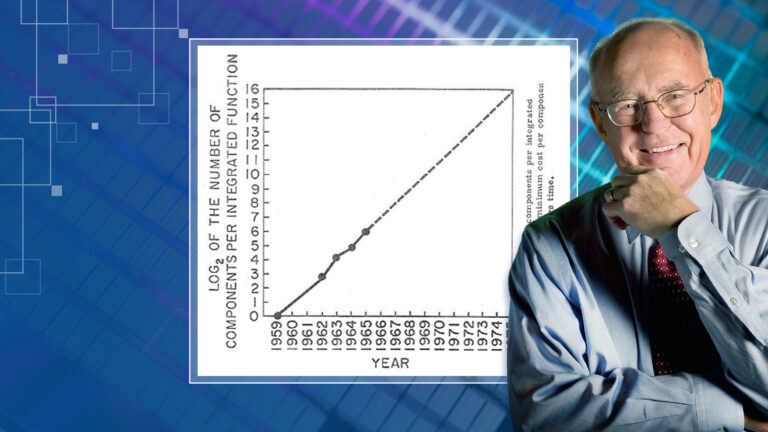

Moore’s Law is the observation that the number of transistors on a microchip doubles approximately every two years. This trend leads to cheaper and more powerful computers over time. However, it is not a physical law like gravity. It is a historical observation and an economic goal set by the semiconductor industry. While the pace has slowed in recent years due to physical limits, the concept still drives innovation in artificial intelligence, mobile devices, and cloud computing. For students in tech fields, understanding this principle is crucial for grasping hardware limitations and the growing importance of software optimization.
Introduction
In the world of technology, few concepts are as famous as Moore’s Law. You hear it mentioned in news reports, tech reviews, and university lectures. It is often cited as the reason why your smartphone in 2026 is vastly more powerful than the supercomputers of the past.
Yet, there is a common misconception surrounding this term. Many people believe it is an unbreakable rule of physics. The reality is quite different. To understand the future of computing and how to prepare for a career in tech, you must understand what Moore’s Law actually is, why it is failing, and why it still matters.
What Is Moore’s Law?
The story begins in 1965. Gordon Moore, the co-founder of Intel, published a paper in Electronics Magazine. He observed a trend in the early days of integrated circuits. He noted that the number of components per integrated circuit was doubling every year.
He later revised this prediction. The standard definition we use today states that the number of transistors on a dense integrated circuit doubles approximately every two years. This increase in density allows manufacturers to produce processors that are faster, more energy-efficient, and cheaper per unit of performance.
For decades, this prediction held true. It became a roadmap for the entire semiconductor industry. Companies like Intel, AMD, TSMC, and Samsung used this timeline to set their research and development goals.
Why It Is Not a Physical Law
In science, a law describes a universal phenomenon that cannot be broken. Newton’s Law of Universal Gravitation is an example. You cannot vote to change gravity. You cannot engineer a way around it.
Moore’s Law is different. It is an observation of market trends and engineering capability. It is more of a self-fulfilling prophecy than a law of nature. The industry strove to meet this goal because everyone expected it to happen.
Physical Limits Are Real
As we move through the 2020s, engineers face significant hurdles. Transistors are now measured in nanometers. At scales like 3nm and 2nm, quantum effects begin to interfere with performance. Electrons can leak through barriers, a phenomenon known as quantum tunneling. This creates heat and errors.
Furthermore, the economic cost of building fabrication plants has skyrocketed. Maintaining the pace of doubling transistors every two years is becoming financially unsustainable for many companies. This is why many experts argue that traditional Moore’s Law is ending or has already ended.
Relevance to Modern Technology in 2026
Even if the original timeline is slowing, the spirit of Moore’s Law drives modern tech. Here is how it impacts the landscape today.
Artificial Intelligence and Machine Learning
AI models require massive computational power. The growth of Large Language Models and generative AI relies on hardware improvements. While transistor scaling is harder, manufacturers now use specialized architectures. They focus on chips designed specifically for AI workloads rather than general-purpose CPUs.
Mobile and Edge Computing
Your mobile device benefits from decades of scaling. High-density chips allow for advanced photography, real-time translation, and augmented reality without draining the battery instantly. As traditional scaling slows, the industry focuses on packaging technologies. This includes chiplets, where multiple smaller chips are combined to act as one larger processor.
Cloud Computing
Data centers rely on efficiency. Higher transistor density means servers can do more work while consuming less electricity. This is vital for sustainability goals in the tech sector.
Impact on Tech Education
For students and professionals learning about technology, Moore’s Law remains a foundational concept. However, the curriculum is shifting to reflect the changing reality.
Understanding Hardware Constraints
Computer science students must learn that free performance gains are no longer guaranteed. In the past, developers could write inefficient code knowing that the next generation of hardware would fix the speed issues. That era is over. Education now emphasizes writing efficient, optimized code.
Specialization Over Generalization
The days of the general-purpose CPU dominating everything are fading. Tech programs now teach more about specialized hardware. This includes Graphics Processing Units (GPUs), Tensor Processing Units (TPUs), and Field-Programmable Gate Arrays (FPGAs). Students learn to match their software to the right hardware architecture.
Focus on Software Optimization
Because hardware improvements are harder to achieve, software efficiency is the new frontier. Courses on algorithms, low-level programming, and energy-efficient computing are gaining importance. The goal is to do more with the transistors we already have.
Conclusion
Moore’s Law is not a law of physics. It is a historical trend that guided the semiconductor industry for over half a century. While the traditional doubling of transistors every two years is slowing down due to physical and economic limits, its impact persists.
It shapes how we build AI, how we design mobile devices, and how we educate the next generation of engineers. For anyone working in tech, understanding this shift is key. The future is not just about smaller transistors. It is about smarter architecture and more efficient software.
References
- Moore, G. E. (1965). “Cramming more components onto integrated circuits”. Electronics Magazine.
- Intel Corporation. “The Future of Silicon.” Intel Newsroom.
- IEEE Spectrum. “The End of Moore’s Law?” IEEE GlobalSpec.
- Our World in Data. “Transistor Counts on Microprocessors.” University of Oxford.